What Is SASE And How Does It Secure Modern Corporate Networks?

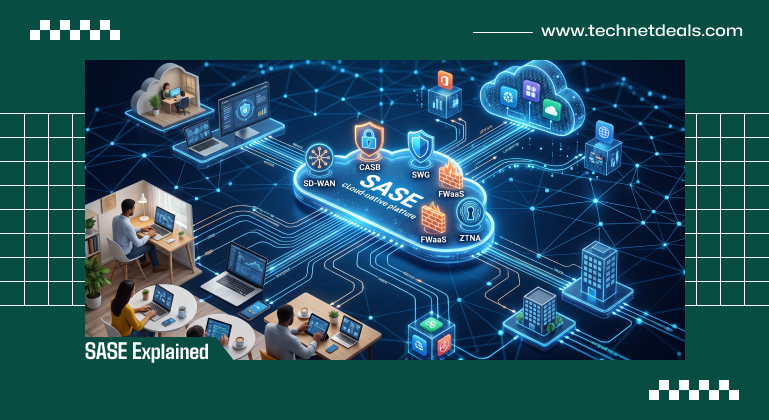
If you want to protect any cloud-integrated enterprise, you need to know about SASE (Secure Access Service Edge).
I see too many C-level executives struggling with the problem of disparate security tools today.
The old perimeter around the data center is disappearing because the data, employees, and applications are everywhere.
But tell me, exactly, what is SASE, and how does it work?
Relationship Between The Networking And Security Components
First, let me write down the relationship between the two types of components, their categories, and functionality. So, in general, SASE is built from two types of components:
- Networking component
- Security component
Here’s how they work:
| Component Category | Element Name | Core Operational Functionality |
| Networking Component | SD-WAN | Decouples network control from physical hardware to dynamically route traffic across multiple connections based on application priority. |
| Security Component | ZTNA | Enforces a continuous, context-aware verification protocol that treats every user and device as untrusted until proven otherwise. |
| Security Component | CASB | Acts as an inline security broker that monitors, audits, and secures user data moving between the enterprise and cloud-hosted SaaS environments. |
| Security Component | SWG | Intercepts web traffic to filter malicious URLs, perform deep packet inspection, and decrypt SSL traffic without added latency. |
| Security Component | FWaaS | Replaces local hardware firewalls with an elastic, cloud-delivered next-generation firewall that applies layer-7 traffic control globally. |
What Is SASE?
To build a correct understanding of the concept, you need to know first what SASE stands for. It is the acronym for Secure Access Service Edge, as I have already mentioned above.
Pronounced “sassy,” this term was first used in Gartner’s reports. SASE is not a software product that you can install on the enterprise’s premises.
Here are some key features of the concept:
- Cloud-Native Architecture: All of the security tools are built into the network platform, not the other way around.
- Gartner Origin: The concept was proposed by the Gartner analysts in 2019.
- Identity-Centric Access: The identity of the user, device, or application is the deciding factor in the SASE security authorization process.
- Legacy Replacement: SASE eliminates the need for single-use legacy point solutions or even purpose-built hardware appliances.
Core Operational Mechanics Of SASE
Perhaps the easiest way to see how a SASE architecture fundamentally differs from legacy systems is to look at the process behind getting data traffic from the user’s device to the corporate resource.
Traditional enterprise networks required remote devices to send data to the corporate data center before routing it onward to the cloud.
In contrast, the cloud-native system has dramatically changed the paradigm: it now routes packets from the nearest point of presence directly in the cloud without passing through the data center.
Here are the main differences in the operation of the SASE architecture:
- Edge Point of Presence Connection: Users connect to the nearest Points of Presence in the cloud instead of the company’s data center;
- Single-Pass Traffic Processing: The cloud security engine processes packets through all security checks at once, not through multiple inspection engines;
- Contextual Access Policy Enforcement: The system actively analyzes the user’s role, device’s attributes, location, and data sensitivity before granting access;
- Continuous Session Verification: Beyond the initial inspection, the architecture also looks for threats in real-time during the session;
The Realities Of AI Integration In Edge Security
Now, many companies utilize vague statements about artificial intelligence to hype up their wares.
To understand how AI-driven security systems work, I studied technical white papers on SASE architecture from Versa Networks and Palo Alto Networks.
Let me share with you the most interesting things I found there.
- Automated Threat Prevention: The system automatically prevents threats and malware that try to gain unauthorized access to the network. For example, machine learning can identify polymorphic malware at the Point of Presence;
- Dynamic Network Routing Optimization: With the help of deep learning algorithms, local network outages can be mitigated by automatically redirecting voice traffic flows;
- Generative AI Security Posture Management: Generative AI security tools are used, for example, to prevent employees from accidentally sharing sensitive information on external platforms;
- Automated Device Classification: AI classifies endpoints, for example, allowing unsecured IoT devices to be placed in a separate security zone;
Technical Differences And Deployment Strategies
I often come across the opinion that Security Service Edge (SSE) is the same thing as a complete end-to-end platform.
I want to clarify once and for all what the primary difference between them is. So, here are the critical distinctions between SSE and SASE that will help you avoid confusion:
| Architectural Framework | Architectural Scope | Network Infrastructure Inclusion | Key Implementation Goal |
| SASE | Full Convergence | Integrates both global software-defined WAN transport fabrics and modern cloud-centric security layers. | Complete WAN and security consolidation across all globally distributed offices, data centers, and remote devices. |
| SSE | Security Subset | Focuses solely on the cloud-delivered security services, excluding the underlying network routing engine. | Enhancing access control and web filtering when an enterprise chooses to keep its existing routing hardware intact. |
Hidden Operational Costs And TCO Variables
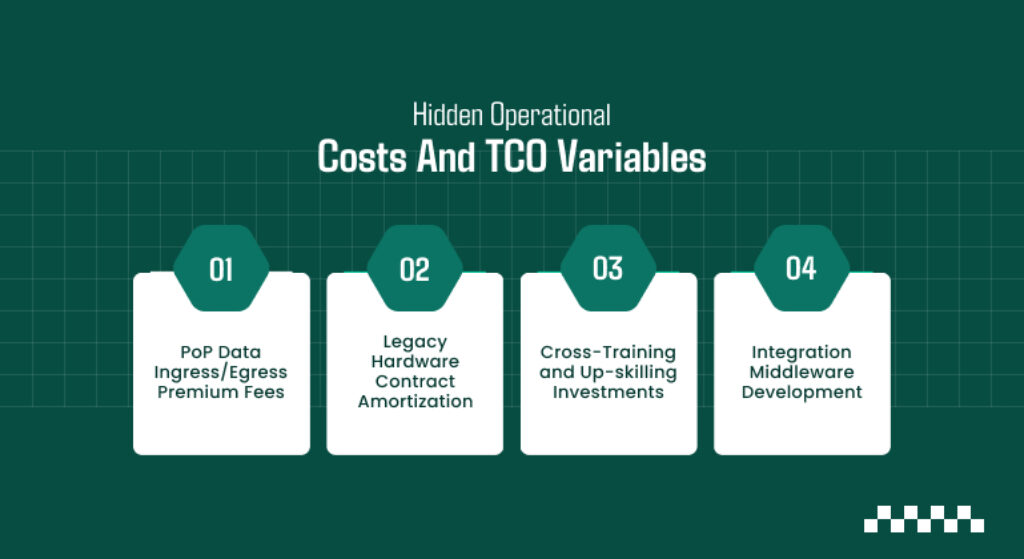
Even though this cloud-native solution eliminates the need to purchase and maintain hardware, there are also some additional costs associated with this type of system.
For example, companies should be prepared for the following expenses related to the software-defined network:
PoP Data Ingress/Egress Premium Fees:
In addition to the standard subscription, enterprises may be charged extra fees for bandwidth-heavy traffic that crosses international borders.
Legacy Hardware Contract Amortization:
If you have previously invested in physical site routers, you will have to finance their continued operation for several years.
Cross-Training and Up-skilling Investments:
Organizations must train network and security engineers to manage the software-defined network infrastructure.
Integration Middleware Development:
If you want to integrate the SASE architecture with your legacy on-premises applications, you will have to invest in middleware development.
Local Data Sovereignty And Compliance Challenges
By placing data on third-party platforms, companies run the risk of violating local data privacy laws.
When choosing a particular provider, enterprises must be especially careful about the following three issues:
- Cross-Border Inspection Constraints: The encryption engine must be configured so that private employee data is not inspected when located on a foreign PoP;
- Geographical Point of Presence Constraints: Data must reside in local PoPs if the company operates under GDPR or HIPAA regulations;
- Data Log Isolation Requirements: To comply with local regulations, enterprises must store their security logs separately in isolated logs;
Interoperability Protocols With Legacy Infrastructures
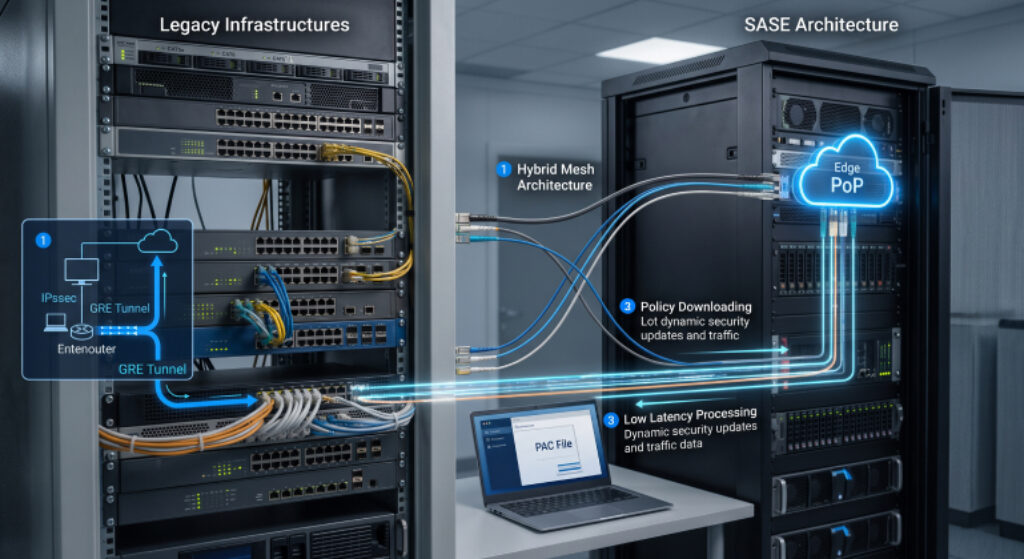
It is not necessary to replace all the enterprise’s hardware platforms at once. Using the standard network infrastructure tools, you can establish interoperability with the SASE architecture:
- IPsec and GRE Tunneling: Existing branch office routers can be used to establish IPsec or GRE tunnels to the cloud’s nearest Point of Presence. This will allow remote users to access secured web resources.
- PAC File and Agentless Redirection: Unsecured endpoints can be redirected through the secure web gateway by using the proxy auto-configuration file.
- Hybrid Mesh Architecture Anchors: The physical firewall can act as a hybrid network anchor, allowing local traffic to be processed with low latency while downloading the latest security policies from the SASE cloud.
Step-by-Step Practical Migration Blueprint
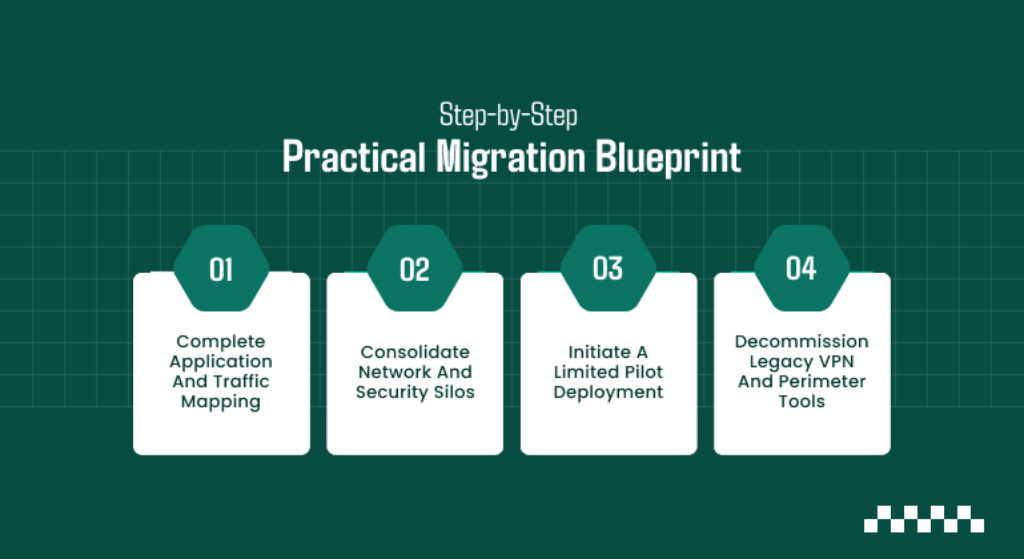
When you have an operational blueprint, you need to follow certain steps to migrate your enterprise infrastructure. To ensure sufficient security while accelerating the process, I recommend following this step-by-step guide:
Complete Application And Traffic Mapping
First, you need to analyze your current state. Make a list of all SaaS applications, databases, and remote users that need to be connected. You should also make a diagram of your company’s traffic flows for each division.
Consolidate Network And Security Silos
It is necessary for the network and security engineers to consolidate and operate within the new framework. The enterprise must form a combined team to coordinate all activities.
Initiate A Limited Pilot Deployment
A pilot project allows you to test the functionality of the future system. You need to configure the software-defined client on one of the remote divisions to observe their traffic flows. It is also essential to check if the selected tools meet the performance needs of the enterprise.
Decommission Legacy VPN And Perimeter Tools
Finally, you need to decommission the existing infrastructure. It is necessary to get rid of the old firewalls and those slow and ineffective hardware VPNs.