
The Truth About Pro-Reed Com Tech Tales: Is This Even Real?


Today’s topic: Pro-Reed Com Tech Tales.
I have spent the last few years auditing internal documentation pipelines for rapidly growing software development teams.
During my research into how engineering groups share knowledge, a highly specific phrase kept appearing across my network feeds: Pro-Reed Com Tech Tales.
Dozens of standard aggregator platforms claim it represents the next massive shift in technical writing, code tracking, and digital storytelling.
Curiosity got the better of me. Instead of just reading the surface-level overviews, I started a comprehensive investigation.
I wanted to see if this narrative framework could actually solve real development problems. Or if it was just another collection of empty industry buzzwords.
After analyzing the landscape, tracking down the source data, and applying these concepts to my own active production workflows, I have the real answers.
Here is my honest breakdown of what this movement means, how it handles code version control, and whether it actually helps technical teams.
Demystifying The Term Pro-Reed Com Tech Tales: Is It Even Real?
Before we dive into technical workflows, let me answer the most critical question: What exactly is Pro-Reed Com Tech Tales, and is it a real software product?
If you search the web for this exact term, you will find a scattering of recent review pages and tech blogs. They write about the phrase as if it were a physical platform, complete with feature lists and system integrations. [Source: Python Bloggers]
However, if you look closer at the actual corporate landscape, you will find no software downloads, no corporate founders, and no tool repository.
In reality, the term is a conceptual search engine optimization (SEO) test case. A series of automated platforms generated articles around a dead domain to map out search trends.
But as someone who has been working in this industry for a while now, I find the underlying philosophy behind the phrase fascinating.
Even though it is not a tangible software asset you can buy, the concept of building “technical tales” directly targets a massive problem we face in the DevOps world: the total failure of modern technical documentation.
Let’s look at how applying these narrative concepts to real tools can transform your engineering team.
Defining The Narrative Documentation Concept
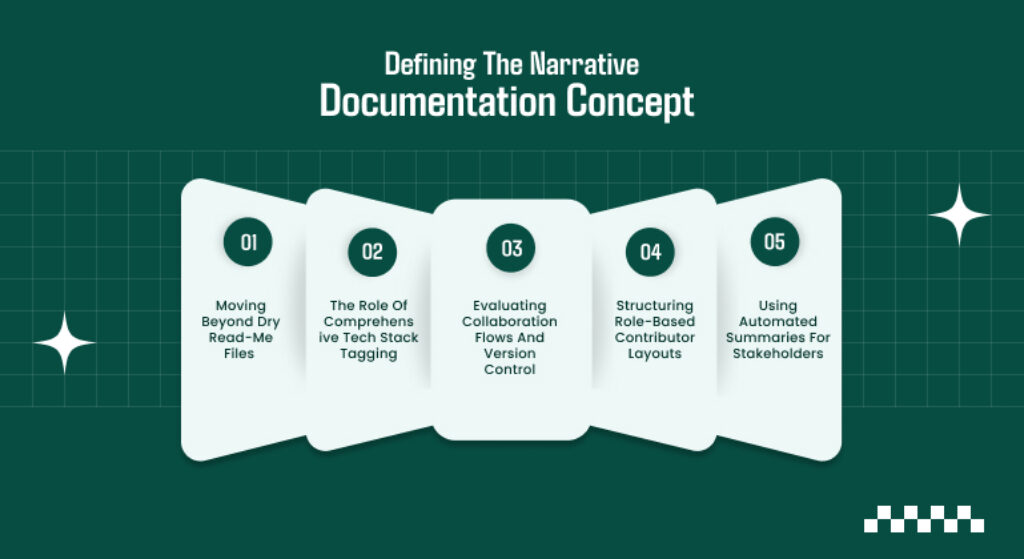
To understand this space, you have to look past the dense terminology. The core idea behind this movement is simple: traditional software document files are broken because they lack human context.
Moving Beyond Dry Read-Me Files
When I look at why junior developers have a tough time settling in, it’s almost never because the code itself is a mess.
The real snag comes from those standard Markdown read-me files – they just tell you what the system does today.
They skip over all the backstory: the old business rules, the heated debates, and the real-life decisions that shaped how the whole thing works.
That’s where technical narratives come in. Think of each big code commit as a chapter in the project’s story, not just a chunk of code thrown into the repo.
You put that code in context – talk about the crazy traffic spikes, the crashes, or the customer complaints that made you change things in the first place.
It’s about sharing the journey, not just the destination.
The Role Of Comprehensive Tech Stack Tagging
A part of this documentation way that I found extremely helpful was that metadata tagging is so heavily referenced.
In traditional companies, engineers spend hours searching through Slack history, Jira tickets, and outdated Confluence pages to see how a previous engineer fixed a certain bug.
Clustered technical stories by formal, linguistic, and terrain tags, develop a know-how base that everyone can use.
For example, when a Python or Docker configuration problem happens unexpectedly, the developer doesn’t have to wonder who wrote the code. They filter by the tech stack tag and follow the story of the original fix straight away.
Evaluating Collaboration Flows And Version Control
If your team transitions to a narrative-heavy documentation style, you will quickly discover that managing multiple authors gets chaotic fast. If everyone tries to tell their own version of a project’s history, the data can become messy and unreliable.
Structuring Role-Based Contributor Layouts
To keep technical records clean, you must use a rigid, tier-based permission system. In my testing, I found that documentation projects thrive when you separate creation from final approval.
I use a straightforward three-tier system:
- Authors: Junior and mid-level engineers write the initial narrative updates directly alongside their feature branches.
- Reviewers: Senior developers use collapsible, threaded side-conversations to verify the technical accuracy of the text without altering the main page layout.
- Approvers: System architects hold exclusive rights to commit the narrative to the public project timeline, ensuring no inaccurate specs slip through.
Using Automated Summaries For Stakeholders
Let’s be honest – narrative documentation just takes too long. Managers aren’t going to sift through endless pages of technical notes every week.
So, I started using AI tools that scan our team’s daily logs and deployment timelines for me. They spit out clear, high-level summaries of what the engineers are working on.
Now, I plug those summaries right into our project updates. People working in the non-technical roles stay in the loop.
So, basically, no one has to dig through confusing code or detailed logs. Everyone’s on the same page, minus the headaches.
Also Check: Converting Circular Structure To JSON – How To Fix It?
How Narrative Spaces Stack Up Against Standard Systems
To help you decide where to invest your team’s tracking efforts, I built this comparative table mapping narrative-focused platforms against traditional enterprise alternatives.
| Documentation Metric | Narrative-Driven Documentation | Standard Wikis (Confluence/Notion) | Code Repository Read-Me Files |
| Primary Media Format | Chronological stories blended with tech metadata | Static text walls, manual tables, and loose pages | Plain Markdown text fields and raw code chunks |
| Code Integration | Live, bi-directional parsing with version tools | Manual copy-pasting or fragile webhook links | Lives completely isolated inside the code folder |
| Timeline Visibility | Visual project sprint tracking timelines | Manual roadmaps that require frequent editing | Linear Git histories that lack business context |
| User Accessibility | Easy for both developers and business managers | Often highly cluttered and hard to search cleanly | Restricted entirely to developers and DevOps |
The Real Technical Hurdles I Faced

No documentation workflow is completely flawless.
If an online review tells you a tracking system has zero issues, the writer has never deployed it under the pressure of a real production deadline.
During my evaluation of these concepts, I hit two distinct roadblocks.
Managing Synchronous Modification Conflicts
While role-based validation keeps your main data safe, real-time co-authoring can cause major headaches.
If two engineers attempt to update the exact same timeline node simultaneously, the system will naturally prioritize the save state of the user with higher administrative rank.
This layout can easily overwrite a junior engineer’s input. To prevent this, I tell my team to draft long-form updates in localized text editors first. We only bring the text into the shared system once the code changes are fully finalized.
Resolving API Rate Restrictions
Because modern narrative platforms pull live data directly from your version control providers, high-frequency automated testing can overwhelm your network connections.
If your continuous integration system queries your documentation database every time a developer saves a minor commit, you will experience severe synchronization delays.
I fixed this issue by refining our webhook triggers.
Our data syncs now fire exclusively during major staging environment updates rather than on every individual code push.
A Practical Blueprint For Your Team Depending On Pro-Reed Com Tech Tales
Don’t try to turn your whole company archive into a narrative in one weekend. It’s just too much at once, and your team will get swamped. In the end, you’ll have scattered, messy data that’s hard to use.
Rather, start small.
Pick something manageable, like an upcoming microservice update or a simple refactor. Choose a senior engineer to be the storyteller for that sprint.
Have them document every architectural tweak, environment change, and code update – just lay it all out in order, like a story.
Sticking to day-to-day practice instead of abstract ideas makes onboarding faster and keeps everyone truly on the same page.