


Today’s topic: Should you buy the Sony a7R V Mirrorless Camera?
Buying a high-resolution body will be one of the most expensive purchases you can ever make as a visual creative.
There are many different specs pages and marketing claims about how incredible it is with huge megapixel counts and AI.
But if you’re looking into purchasing this camera, you need to know how fast and efficient this camera is in real world situations.
I’ll break down exactly what this system offers, how it performs and what hidden features it has to help you decide if it’s worth your hard-earned cash.
Sony a7R V Mirrorless Camera: Technical And Market Overview
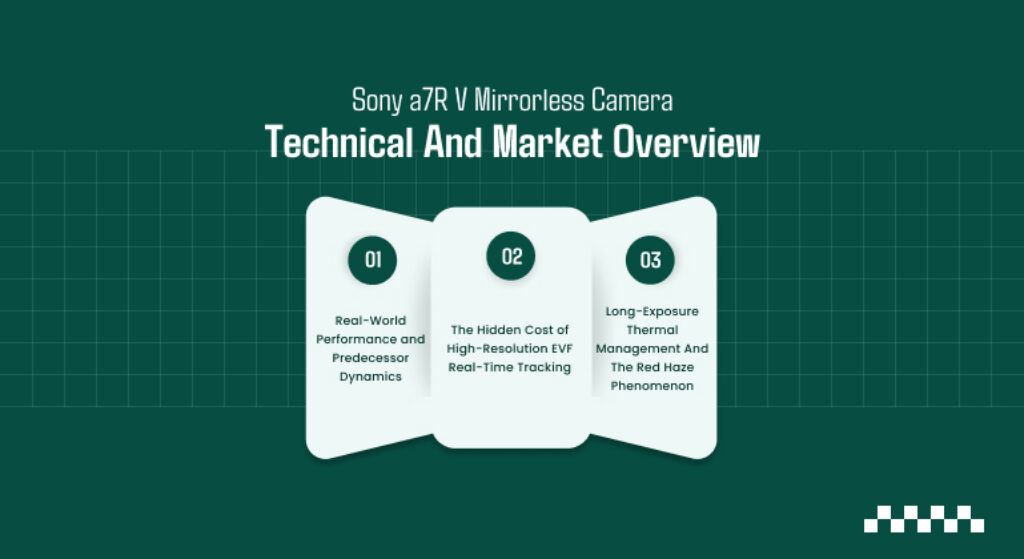
To determine if the Sony a7R V Mirrorless Camera is worth purchasing, let’s start by determining what it actually offers.
This 5th-generation camera doesn’t offer a huge boost in resolution, but it has refined how it handles data.
It has the same 61MP back-illuminated Exmor R CMOS Sensor as the previous model but has upgraded its processing with two BIONZ XR processors and a dedicated AI chip.
This camera is marketed as a premium product in India. The official model name is ILCE-7RM5 (Body Only) and costs Rs. 3,53,990.
Due to its high price point, data requirements, and feature set, it should be noted that the online spec sheets claiming that this camera is “ideal for a complete beginner” are completely wrong.
This is a serious professional camera that is designed for fine art landscape creators, commercial portraits and wildlife professionals. It offers incredible detail, large amounts of cropping, and a robust build.
Below is a table showing the key specifications of this camera.
| Category | Specs | Use |
| Camera Sensor | 61.0 Mega Pixels – High Sensitivity Full Frame Exmor R BSI CMOS | Provides excellent micro contrast while maintaining excellent detail. Can crop images to suit your printing requirements. |
| Processor | BIONZ XR With AI Processor | Quick real time processing to evaluate objects using algorithms. Offers quick control. |
| In-body image stabilisation | 5 Axis In-body sensor shift (Up to 8.0 Stops) | Offers greater stability for handheld shooting in low light conditions. |
| Autofocus System | 693 Phase Detection Points (79%) | Offers dense coverage of autofocus points to offer accurate subject tracking across the entire frame. |
| Storage | Double Slot – CFexpress Type A / SD (UHS-II) | Can divide between cards to ensure data is safe or for maximum write speeds. |
| Price | Rs. 3,53,990 (Body Only) | A long term investment for business or serious enthusiasts. |
Real-World Performance And Predecessor Dynamics
Let’s look at how this camera performs in real-world situations to really understand if the Sony a7R V Mirrorless Camera is worth your money!
The main reason why we’d want to purchase this camera is due to the new processing speed. Both cameras have a 61MP sensor. So it’s not the resolution. Rather, it’s how quickly it processes what you’re taking.
The addition of the BIONZ XR processing removes any data lag issues that high-megapixel cameras normally face.
Although the camera still has a 10fps burst rate with full AF/AE tracking (to differentiate it from the sports-focused Alpha 1), the buffer has been transformed.
Below is a table showing the difference between each generation.
| File Format Variant | Legacy a7R IV Buffer | New a7R V Deep Buffer | Advantage / Use Case |
| JPEG (Fine) | 68 | 1000 + | Deep buffering to give near endless buffering for fast moving shots. |
| Compressed RAW | 68 | 583 | Fast wildlife shooting with no worries of buffer locks. |
| Uncompressed RAW | 30 | 135 | Long maximum buffer for maximum quality shots. |
| Lossless Compressed | N/A | 547 | Great compromise for a larger buffer of raw files with smaller file sizes. |
With the previous 4th generation cameras, if you were to take a long burst of images, the camera would quickly become unresponsive.
Whereas with the a7R V, it acts as though it has an infinite buffer. As the camera processes data so quickly, it barely interrupts your workflow.
There are now 3 different sizes of Lossless Compressed RAW files. This allows you to reduce the file size by up to 80% without losing any information from the sensor. This solves any issues you’d face with large 61MB files if you aren’t using the full resolution.
Related Article For You: Canon EOS R Review: Best Mirrorless Camera For Travel Photography
The Hidden Cost Of High-Resolution EVF Real-Time Tracking
Every technical review will note that this camera has an incredible 9.44 million-dot OLED EVF with a 120fps refresh rate. However, there is an issue with this camera that most online sources ignore.
If you enable Continuous AF (AF-C), you’ll notice that the EVF will begin to reduce its resolution. This is because the camera will be putting more focus on processing the AI tracking and focusing rather than displaying the full resolution.
This won’t affect your ability to focus but if you’re expecting to see the full 9.44 million dots whilst taking a 10fps burst, you’ll notice a loss in sharpness.
However, the real benefit comes when you’re reviewing your images. The camera has increased the default magnification compared to previous models.
This allows you to check that your images are pin sharp and have great shadow detail without having to load them onto your computer.
Long-Exposure Thermal Management And The Red Haze Phenomenon
If you’ve taken long exposures, astrophotos or clean dark skies before, you’ll have noticed that you can get sensor noise or sensor glow.
When taking long exposures longer than 60 seconds, the high-megapixel full-frame sensors will generate a lot of heat. This causes a red glow to appear on the edges of your RAW files.
Although this camera has a new useful Internal Programmable Bulb Timer that allows you to set your exposure up to 15 minutes without an external cable, you will still experience heat issues.
After prolonged use in high-contrast night scenarios, a great way to reduce this issue is to fully extend the 4-axis multi-angle LCD and open all the rubber ports.
By having the LCD fully extended, the heat generated will be trapped behind the sensor. Allowing the magnesium alloy body to breathe will significantly reduce the temperature inside your camera, keeping your long exposure RAW files sensor clean.
Sony a7R V Mirrorless Camera Genre-Specific Field Capabilities Breakdown
The main difference this camera has to others is its AI object recognition. This camera doesn’t just look for human eyes but uses its dedicated AI chip to recognise human shapes using human pose estimation.
This means that even if your subject turns around, wears a helmet or gets temporarily blocked by someone else, the camera will still stay focused on them.
The camera also has 693 phase detection points covering around 79% of the full frame. This gives excellent edge to edge focusing. The camera also has dedicated focusing modes for insects, birds, cars, trains and planes.
Below is a table showing how the new firmware settings and design features can help with different genres of photography.
| Genre | Key Features | Main Benefits |
| Landscape and Astro | Focus bracketing, 15 min bulb timer, Shutter shield, Full-frame AF | Automatic depth stacking, no remote cable needed, dust-free lens changes. |
| Portrait and Commercial | AI human detection, Portrait AE, 4-axis screen, Lossless RAW | Eye AF when eyes are hidden, balanced backlit skin tones, easy tripod framing. |
| Wildlife, Sports and Action | AI tracking, Large buffer, 8.0-stop IBIS, Dual CFE slots | Instant subject lock, continuous shooting, steady handheld telephoto tracking. |
The Final Verdict: Is The Sony a7R V Mirrorless Camera Worth It?
If you’re focusing on static portraits or landscapes and have plenty of time to manually focus, you’ll get a very similar result from your current kit or a used 4th generation camera.
However, if you want to make your workflow as smooth as possible, then this camera is definitely worth buying.
The multi-axis articulating screen, massive buffer, in-camera focus bracketing folders, shutter shield, and sticky AI focusing will transform how fast you can work.
Although it is expensive, if you need a high-resolution camera with modern speed, this is an incredibly reliable option.
Additional Resource: Canon EOS R Review: Best Mirrorless Camera For Travel Photography


